



The Lenten Season
The season of Lent is a Catholic liturgical season consisting of forty (40) days of fasting, prayer, and penitence beginning at Ash Wednesday and concluding at sundown on Holy Thursday. On the evening of Holy Thursday, the Sacred Triduum beings.
The official liturgical color for the season of Lent is violet.
Important Days of Lent
- Ash Wednesday: Marks the start of Lent and the time for penance. Obligatory day of fasting (ages 18 to 59) and abstinence (ages 14 & over).
- Fridays of Lent: Obligatory abstinence (ages 14 & over). All Fridays (even outside of Lent) are days of penance.
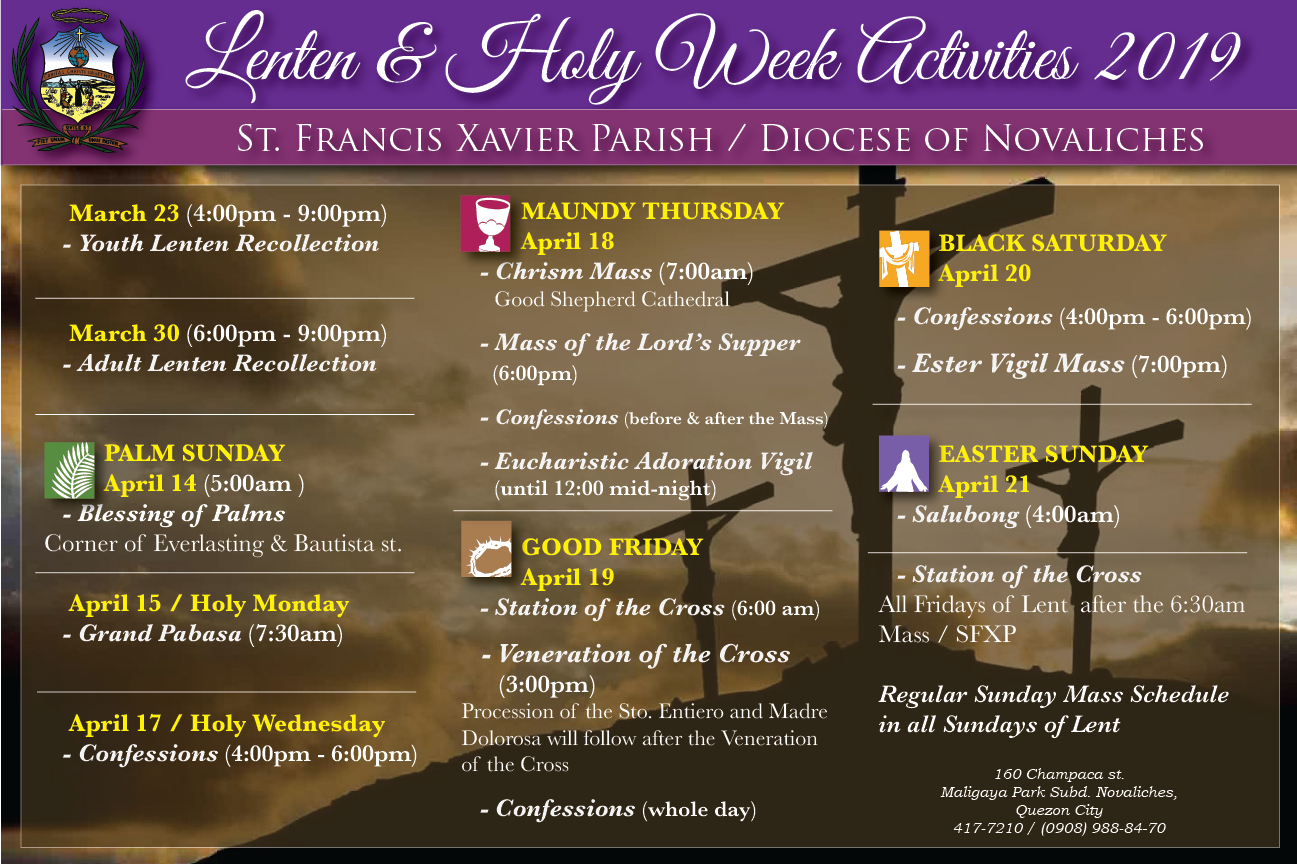
- Holy Thursday: Lent ends and the Holy Triduum begins in the evening with the commemoration of the Institution of the Eucharist at the Last Supper.
- Good Friday: The anniversary of the Crucifixion of Christ (no Mass). Obligatory day of fasting (ages 18 to 59) and abstinence (ages 14 & over).
- Holy Saturday: Christ is in the grave conquering death and freeing the captives. The final day of Lenten fasting (no daily Mass, Easter Vigil begins at sundown).
- Sacred Triduum: The period of 3 days (Holy Thursday + Good Friday + Holy Saturday) during which we remember Christ’s Passion, ending at the Easter Vigil (Saturday evening).
- Easter Sunday: Lent has ended and the joy begins, the day of Christ’s resurrection, the principle Christian feast of the entire liturgical year. This is the celebration of Christ’s victory over sin and death merited for us by his passion, death, and resurrection from the dead on Easter Sunday.
Obligatory Duties for Catholics During the Lenten Season
- Fasting & Abstinence: Our obligatory duty on Ash Wednesday and Good Friday.
- Abstinence: Do not eat meat on the Fridays of Lent. Treat it as a day of penance
- Confession: Catholics are obligated to fulfill their Easter Duty by receiving Holy Communion at least once during the Easter season (from Easter Sunday to Pentecost), therefore the Sacrament of Penance for any mortal sins is required prior to this, and is strongly recommended as a Lenten penitential practice for any venial sins prior to the Easter feast.
The Three Traditional Pillars of the Lenten Season
Many Catholics were taught as children to “give up something” for Lent. The sacrifices in Lent are really penance, in the same spirit as the Ninehvites that repented at the preaching of Jonah. Throughout our history, Christians have found prayer, fasting, and almsgiving to be an important part of repentance and renewal. Many Catholics now add something during Lent rather than giving up something, either to address personal habits that need work or to add some outreach to others in need.
A three-legged stool requires the presence of all three legs to prevent it from falling over. The season of Lent can be compared to a three-legged stool. On Ash Wednesday, Jesus tells us in the Gospel from Matthew (6:1-6; 16-18) that Lent has three pillars—like the stool. They are prayer, fasting, and almsgiving.
Prayer develops our relationship with God; Fasting affects our relationship with ourselves, and Almsgiving helps us focus on our relationships with others. All three pillars are needed for us to remain steady and balanced, much like the three legs of a stool are needed for it to remain upright.
References:
- http://www.aboutcatholics.com/beliefs/lent-in-the-catholic-church/
- https://www.catholiccompany.com/getfed/lenten-season-101/
- http://www.josephites.org/3-traditional-pillars-of-lenten-observance/
- https://blog.misacor-usa.org/the-three-pillars-of-a-fruitful-lent